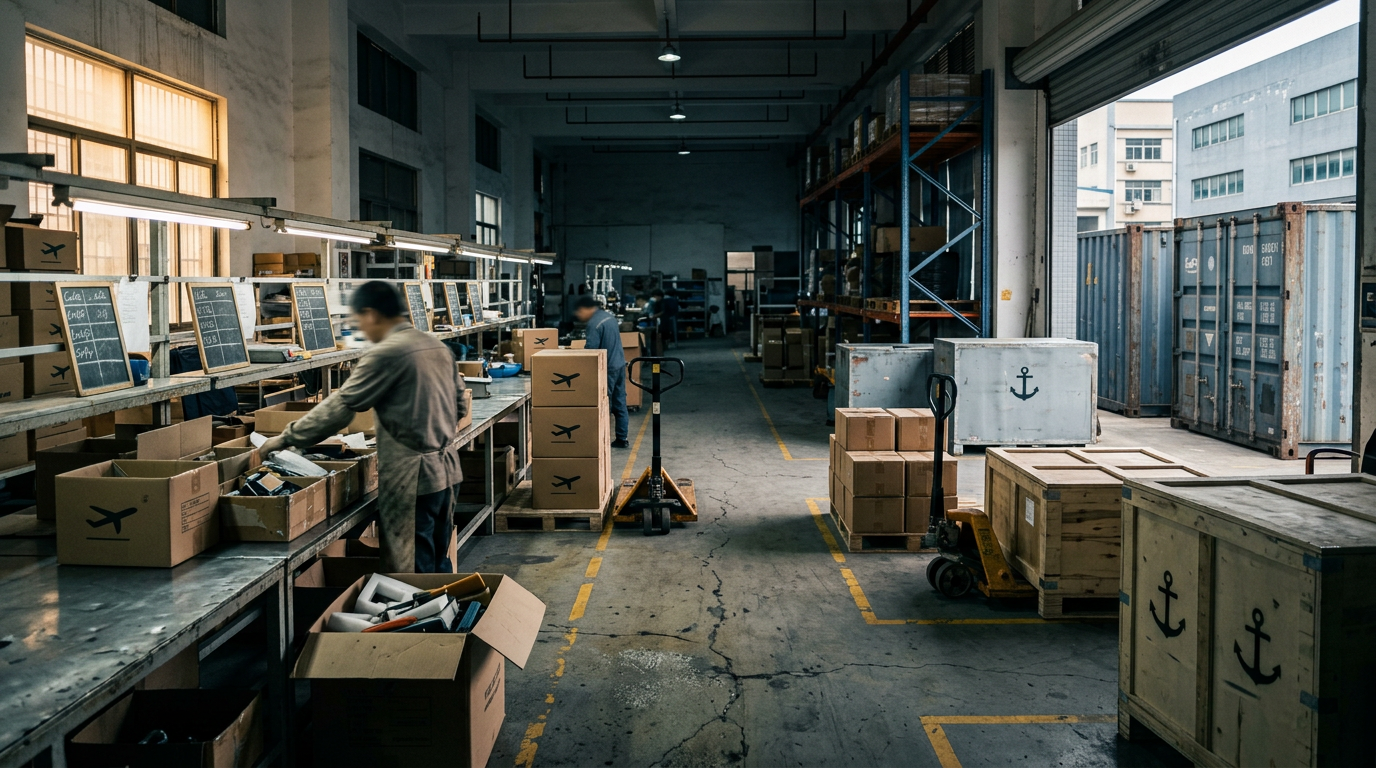
The decision between air and ocean freight from Shenzhen is a critical logistics variable that directly impacts landed cost, delivery speed, and overall supply chain resilience for international SMEs. As businesses plan for 2025, the calculus of this decision rests on a fundamental trade-off between the velocity of air cargo and the economic scale of ocean shipping. This choice is not merely operational; it is a strategic determination influenced by product value, market demand, and inventory philosophy. For any company importing OEM products or components from China's manufacturing heartland, understanding the precise scenarios where each transport mode excels is essential for maintaining a competitive edge and ensuring profitability in an ever-fluctuating global market.
Air freight is the fastest method for transporting goods internationally, with its primary advantage being unparalleled speed. A typical door-to-door shipment from Shenzhen International Airport (SZX) to a major North American hub like Los Angeles (LAX) or a European one like Frankfurt (FRA) can be completed in just 5 to 10 days. This velocity is indispensable for time-sensitive cargo. Common use cases include high-value electronics where holding costs are significant, components needed to prevent a production line stoppage, or the launch of a new product with a narrow market window. For fashion and seasonal goods, air freight ensures products are on shelves during peak demand, preventing lost sales and costly end-of-season markdowns.
The primary drawback of air freight is its significant cost. Air cargo pricing is determined by chargeable weight, which is the greater of the actual gross weight or the volumetric weight. Volumetric weight is a calculation that accounts for a shipment's density using the formula (Length x Width x Height / Divisor). This pricing model heavily penalizes lightweight but bulky goods. As a general rule for 2025 planning, air freight can be anywhere from 5 to 15 times more expensive per kilogram than ocean freight. This cost is further amplified by variables such as fuel surcharges, security screening fees mandated by bodies like the TSA, and peak season demand, making it a premium solution reserved for urgent or high-margin products.
Conversely, ocean freight is the backbone of global trade, renowned for its cost-effectiveness and immense capacity. It is the most economical method for shipping large volumes, making it the default choice for most mass-market products, raw materials, and heavy industrial goods. Goods are consolidated into Full Container Loads (FCL) for single shippers or Less than Container Loads (LCL) for smaller, combined shipments. Major container ships departing from Shenzhen's world-class ports, such as Yantian and Shekou, can carry over 20,000 TEUs (twenty-foot equivalent units) on a single voyage. This economy of scale drastically reduces the per-unit shipping cost, allowing businesses to price their products competitively in destination markets.
The trade-off for ocean freight's economic advantage is a significantly longer and more variable transit time. While the ocean voyage itself might take 15-30 days, the total door-to-door timeline often extends to 35-55 days. This comprehensive schedule includes crucial steps like inland transport to the port, container loading, customs clearance in China, potential port congestion at destinations like Long Beach or Rotterdam, destination customs processing, and final-mile delivery. Planners for 2025 must buffer for potential delays from weather events, labor disputes, or geopolitical chokepoints, which have caused significant disruptions in recent years, such as those seen in the Red Sea during 2023-2024.
For businesses seeking a middle ground, sea-air freight presents a strategic hybrid solution that balances cost and speed. This intermodal approach involves shipping goods via ocean from Shenzhen to a major transit hub—commonly Dubai (DXB), Singapore (SIN), or Incheon (ICN)—where the cargo is then transferred onto an aircraft for the final leg of its journey. Sea-air solutions typically offer a transit time of 15-25 days, which is consistently faster than pure ocean freight but considerably more economical than direct air freight. This model is ideal for products that can no longer meet market deadlines via ocean but for which the cost of direct airfreight would erase profit margins.
Developing a strategic freight selection framework for 2025 requires a multi-factor analysis beyond just cost and speed. Businesses should evaluate each shipment against a clear set of criteria to make an informed decision. Key factors include: - Product Value and Margin: High-value goods, such as medical devices or advanced electronics, can often justify the higher cost of air freight to reduce the capital tied up in transit and minimize risks of damage or theft. - Product Lifecycle: New product introductions and items with short seasonal selling windows necessitate the speed of air freight. Stable, evergreen products with predictable demand are ideal candidates for ocean freight. - Weight and Density: Heavy and dense goods like machinery parts or ceramic tiles are prohibitively expensive to ship by air and are almost exclusively sent by sea. Conversely, light but bulky items are penalized by air freight's volumetric weight rules. - Inventory Strategy: A Just-in-Time (JIT) inventory model may require more frequent, smaller air shipments, whereas a model with larger safety stocks allows for the longer lead times of ocean freight.
Environmental, Social, and Governance (ESG) considerations are increasingly influencing logistics decisions. Ocean freight is substantially more carbon-efficient than air freight. According to the International Transport Forum (ITF), air cargo can emit over 40 times more CO2 per tonne-kilometer than a modern container ship. For companies with public ESG commitments or customers who prioritize sustainability, opting for ocean freight where feasible is a direct way to reduce the supply chain's carbon footprint. Furthermore, the maritime industry's adherence to regulations like IMO 2020, which limits sulphur content in fuel oil, demonstrates an ongoing commitment to mitigating its environmental impact. This makes ocean freight a more sustainable choice for routine, non-urgent shipments.
As a Shenzhen-based procurement partner, Procubility provides end-to-end management that integrates this complex logistics decision-making into a seamless service. Our process begins long before shipment, influencing product design for efficient transport and sourcing from our network of ESG-compliant suppliers. For each client order, our logistics team performs a detailed analysis based on product characteristics, market deadlines, and budget constraints to recommend the optimal freight mode—whether air, ocean, or a strategic sea-air hybrid. We manage the entire door-to-door process, from factory pickup and export documentation to customs clearance and final delivery, providing our clients with a single source of truth and predictable landed costs for their 2025 supply chain.