Most sourcing failures do not begin on the production line. They begin months earlier, at a desk in Hamburg, Chicago, or Melbourne, when a procurement team reviews a clean presentation deck and mistakes commercial responsiveness for operational capability. A glossy catalog, an active English-language storefront, and swift communication on WeChat create an impression of substance. Yet when you set out to investigate a Chinese supplier, the core objective is not to evaluate their sales talent. The objective is to determine whether the legal entity signing your purchase contract possesses the physical machinery, qualified staff, financial resilience, and statutory permissions required to deliver your goods without exposing your business to severe commercial or legal default.
A formal China supplier investigation differs fundamentally from basic supplier discovery. Sourcing identifies candidates who claim they can build your product; an investigation verifies whether those claims survive independent scrutiny against primary records and physical reality. Overseas buyers frequently discover the difference only after wiring a substantial tooling deposit or production advance. The company with the impressive booth at the Canton Fair in Guangzhou turns out to be an uncapitalized intermediary operating from a leased serviced office in Qianhai, subcontracting production to an unregistered workshop in the rural outskirts of Huizhou with zero quality management systems.
Consider a hypothetical scenario common among growing hardware brands. An electronics importer signs a manufacturing agreement with an enterprise presenting itself as a mid-sized Shenzhen manufacturer of smart home sensors. The supplier presents an ISO 9001 certificate, product test reports, and factory photographs showing clean SMT lines. The buyer wires a thirty percent advance payment of two hundred thousand dollars against a commercial invoice issued by an offshore company in Hong Kong. Three months later, the first production milestone passes without working samples. When delays stretch into four months, the buyer attempts to enforce contract penalties, only to discover that the Hong Kong entity owns no assets, the Chinese business license names an unrelated micro-enterprise in Jieyang, and the workshop photographs belonged to a third-party contract manufacturer that refused the job due to non-payment. The buyer faces total capital loss with zero realistic legal recourse.
A thorough corporate investigation begins with scoping the question. Before requesting documents or hiring inspectors, define what risk profile matters most for this specific purchase order. Are you trying to establish basic identity to prevent wire fraud, or do you need to assess environmental liabilities under European supply chain due diligence mandates? Scoping dictates depth. A low-value spot purchase of off-the-shelf plastic housings requires basic corporate legitimacy verification. In contrast, custom precision tooling requires an investigation into equipment ownership, pending litigation, debt encumbrances, and actual production capacity. Without a precise scope, investigation efforts drift into collecting generic registry sheets that offer false reassurance while leaving critical operational vulnerabilities unexamined.
Once the scope is settled, desk research provides the factual foundation. You cannot rely on documents supplied as low-resolution PDFs over email, because business licenses, test certificates, and authorization letters are routinely altered with image editing software. Every credible China supplier investigation cross-references data against official state databases. Practitioners examine records in the National Enterprise Credit Information Publicity System (NECIPS), provincial market regulation databases, and the Supreme People's Court judicial disclosure platforms. These public registries reveal the registered capital, paid-in capital, legal representative, registered scope of business, operational status, shareholder changes, administrative penalties, and formal inclusion on lists of enterprises with abnormal operations or severe dishonest acts.
Desk research also demands structural analysis. You must trace the relationship between the front-facing sales presence and the underlying production entity. In coastal export hubs like Dongguan, Ningbo, and Wenzhou, manufacturing ecosystems often separate commercial entities from operational assets to shield equipment from commercial disputes. When examining structural relationships, look for five observable signals:
1. The corporate business scope excludes manufacturing (shengchan or zhizao) and specifies only wholesale, retail, or import-export agency services. 2. The paid-in capital is zero or a fraction of the subscribed capital, indicating that the shareholders have committed little real equity to the enterprise. 3. The bank account details on the proforma invoice belong to an offshore entity, an individual, or a third-party payment collector rather than the onshore corporate entity named in the contract. 4. Court records show active civil litigation involving supplier debt, labor disputes, or execution orders (zhixing) that threaten sudden asset freezes. 5. Intellectual property filings and production licenses are held by a completely different company with no clear equity or contractual link to your vendor.
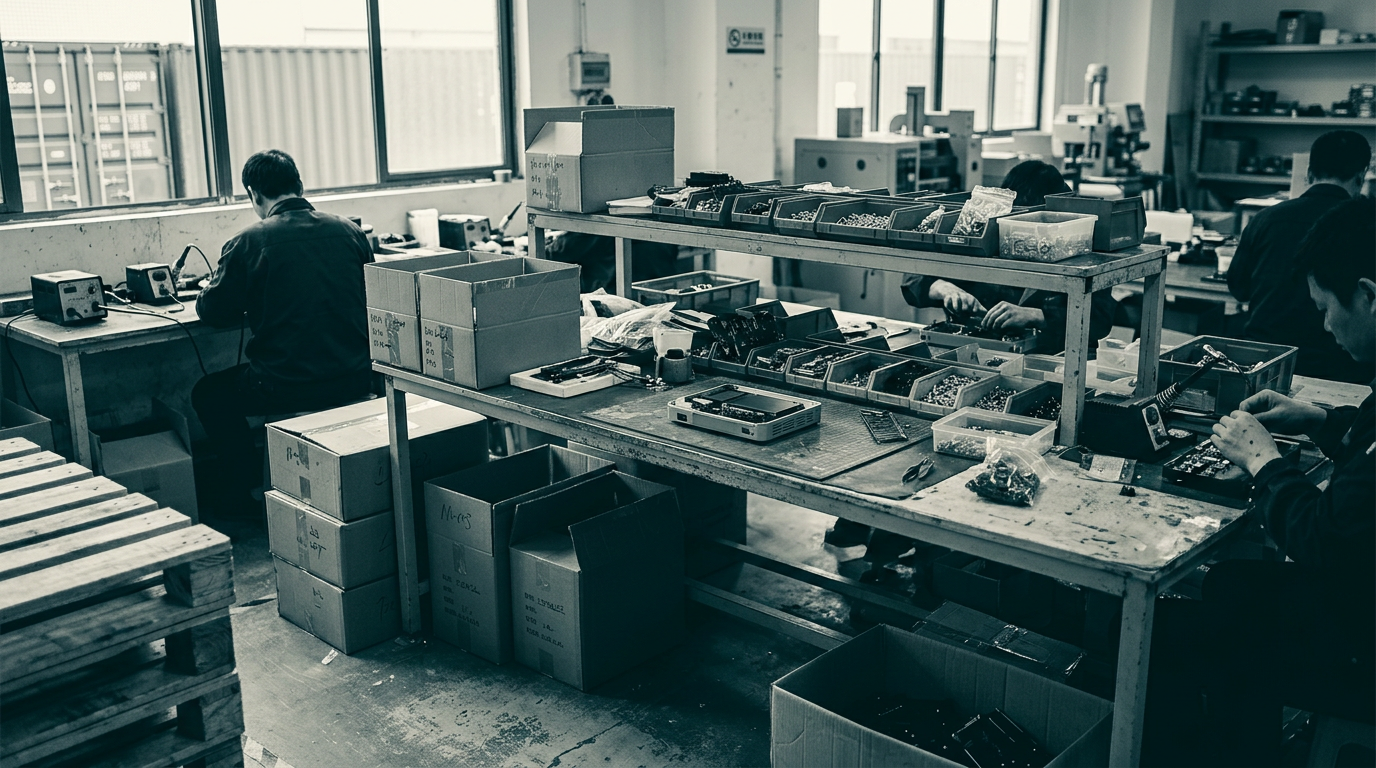
Public records and corporate registries establish legal standing, but paper cannot operate an injection moulding press or inspect circuit boards. Field verification is the irreplaceable second half of any competent inquiry. An investigator or technical auditor visits the physical location registered with the municipal administration. When standing on-site in an industrial park in Bao'an or Foshan, you confirm whether the nameplate at the factory gate matches the enterprise name on the unified social credit code certificate. You verify whether the factory floor houses the CNC machining centers, stamping presses, and automated testing rigs shown in their marketing presentations, or whether the facility is merely a storage warehouse repackaging parts manufactured elsewhere.
Field verification also evaluates human and process reality. An experienced factory auditor observes worker counts, shift schedules, warehouse inventory turns, raw material traceability tags, and calibration stickers on testing equipment. If a vendor claims a monthly output of fifty thousand units but operates only two manual assembly lines with twelve operators and minimal component inventory, the operational numbers do not align. Similarly, reviewing original mill test certificates (MTC), certificates of analysis (COA), wastewater discharge permits, and local social insurance payment records during an unannounced or semi-announced walk-through strips away the staging typical of organized sales visits.
To solve these vulnerabilities systematically, importers should deploy an investigation sequence linked directly to financial milestones. Phase one involves desk research and structural legal analysis before issuing a formal request for quotation or signing a non-disclosure agreement. Phase two requires physical field verification and basic quality systems auditing before paying tooling deposits or signing binding purchase orders. Phase three requires production inspection and bill-of-lading verification before wiring the final balance transfer. By tying investigative checkpoints to cash release gates, you preserve operational leverage and eliminate the risk of chasing unsecured funds through foreign court jurisdictions.
A critical practitioner insight lies in understanding the operational distinction between supplier capacity and supplier commitment. Capacity is what a factory can technically build based on its floor machinery, toolroom tolerances, and engineering staff. Commitment is where your purchase order sits in their operational hierarchy. A tier-one electronics facility in Suzhou may possess outstanding SMT lines and flawless cleanrooms, but if your seasonal order represents two percent of their machine time, your production will be bumped the moment a domestic telecom giant demands priority capacity. Investigating a supplier requires evaluating their client concentration and minimum efficient scale to ensure your account commands genuine operational attention rather than indifference.
The final deliverable of an investigation is reporting and confidence calibration. A professional investigation report does not simply declare a vendor good or bad. It delivers discrete, evidence-backed findings across corporate legitimacy, legal exposure, financial stability, operational capability, and regulatory compliance. Each finding must carry a confidence level rooted in primary documentation, verifiable registry extracts, and documented photographic proof from the production floor. This objective synthesis gives your risk committee or executive team the factual clarity needed to decide whether to proceed, renegotiate contractual protections, demand escrow payment terms, or walk away entirely.
Procubility provides independent, buyer-paid China supplier investigation, factory audit, and verification services for international importers who require unvarnished operational truth. Headquartered in Shenzhen with inspectors across key industrial centers from Guangdong to Zhejiang and Jiangsu, we represent the buyer exclusively. We take no supplier commissions, broker no factory transactions, and sell no placement services. When your balance sheet and brand reputation depend on understanding who you are truly contracting with in China, our team delivers the objective intelligence required to protect your capital.